
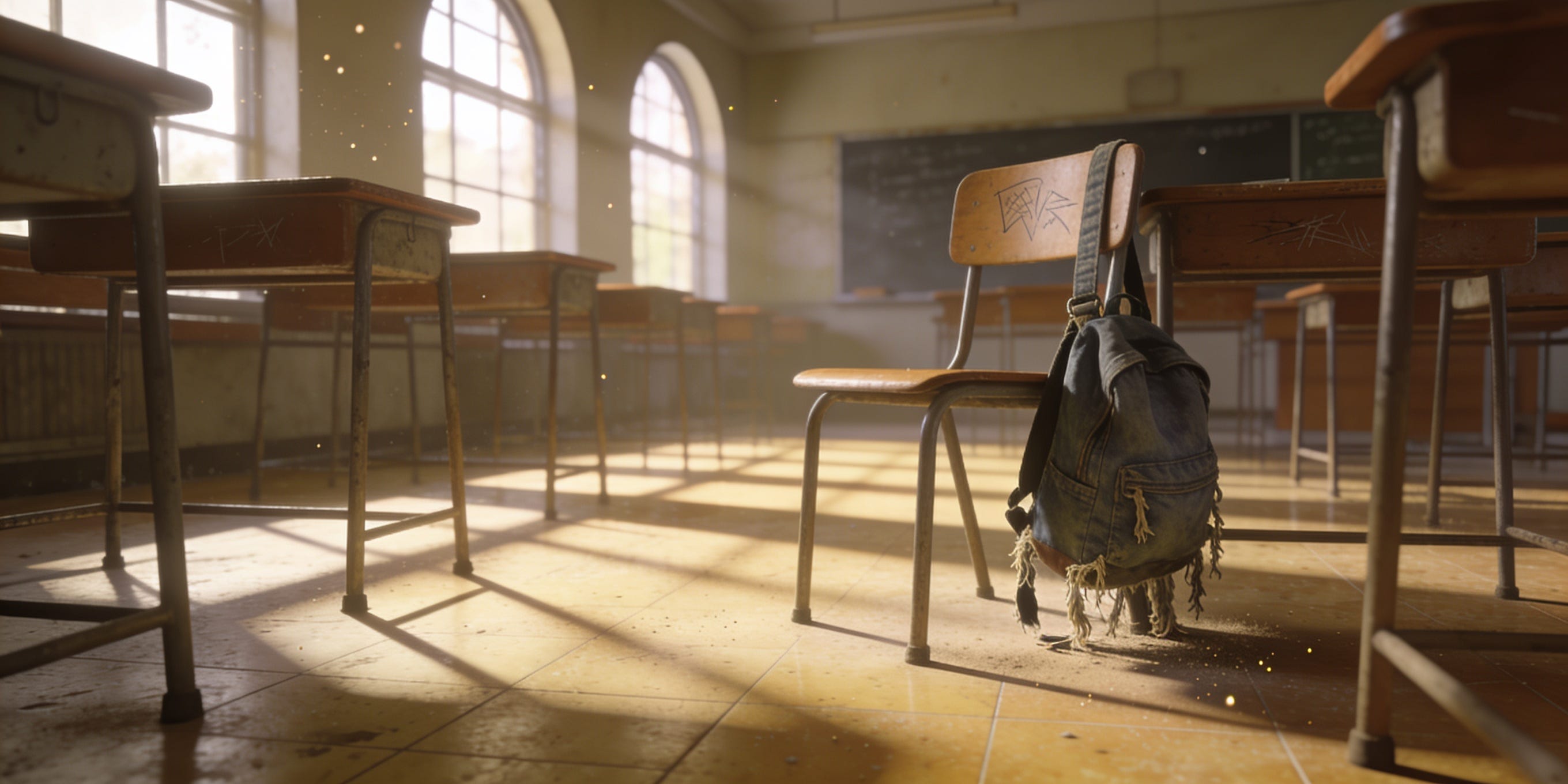
They called him disrespectful, but they were wrong.
You could feel Dereck before he ever spoke.
His presence was always known, because the air had a shift in pressure. His energy was heavy, the kind that made you glance up without knowing why. When he moved, the students’ conversations would soften. Their chairs would still, heads turned toward the doorway watching out of curiosity.
Derek’s shoulders were always squared, movements steady. The room always seemed to make space for him, no matter how crowded. He sat on a chair in the back row, slightly angled, claiming it like it was his own.
He would drop into his chair with a thud, leaning it back just enough for the metal legs to creak. His arms were always folded, one foot stretched forward. And his eyes constantly scanned the room.
He was only twelve, but there was nothing little about his presence.
He carried himself like someone who hadn’t been a child for a long long time. His jaw set with tension, his eyes moved quickly…alert. When he was addressed, he never looked down. He met your gaze directly, steady…unflinching.
And when he talked back, which he did, often…it was never messy or emotional. His words were quick, sharp, hitting exactly where he knew it would hurt. Most teachers called it disrespect. But they were wrong more often than they realized. His words were never careless, they were…gaurded.
The calls to the office came often…it seemed like every day.
“Ms. T, we need you up front.”
The hallway felt colder on those walks. The fluorescent lights flickered, casting a stark glow in the hallway that made everything feel intense. It may have been a different classroom where he would get in trouble, but it was always the same story. A moment where a teacher’s tone carried a little too much edge. An adult looking at him with judgement. A word that didn’t just correct, but felt cutting. And then…you could see it hit him. His shoulders would lock, his head tilted slightly, his eyes would go still. In his mind, a line had been crossed.
Dereck’s voice would rise, fast and immediate. A sound that would cut straight through the room. Then chairs would scrape, and pencils would drop, as everyone in class would hold their breath.
The moment would fracture.
These moments would happen so quickly that most people only paid attention to the explosion. No one ever saw the moment he decided he needed one.
But in my classroom, the air was different. Not because Dereck had changed, but because I had. Instead of reacting to the moments that drew everyone else’s attention, I watched the ones that were overlooked. And what I began to notice was surprising.
At first, I saw how quickly he worked. He never rushed, but somehow he was always finished before everyone else. His pencil rarely paused, it moved across the paper with certainty. He didn’t second-guess himself and when he finished his work he would lean back in his chair, fold his arms, and watch. Not because of boredom, but because he was always on guard.
So one day, I gave him something small to do.
“Dereck, can you take this to the office?”
He didn’t move right away. His eyes met mine, studying me with a long, measured look. As if he was deciding what motive I had in store for him.
Then he stood, took the paper, and quietly left the room.
The next day I handed him a stack of folders and asked if he could organize them for me. He held them for a moment before beginning, then he carefully pressed the corners together. He straightened every page with perfection, tapping the edges against the desk. Making sure all were aligned. Nothing about the way he worked felt rushed or careless. He was always intentional, in everything he did.
After that, I found more reasons to keep him busy. A drawer overflowing with dull pencils. Papers that needed sorting. A supply closet thick with the dry scent of dust. He moved through each job with the same focus. He opened cabinets gently, returned supplies to their proper places, bringing order to things most people would never notice.
As the weeks passed, I noticed small changes. His chair rested on all four legs more often, and the sharp edge in his voice softened. His eyes were still always watching the room, but there were moments when he seemed to forget he was doing it. For a little while he looked like an ordinary sixth grader sitting in class.
Outside my room, the storm followed him wherever he went. The calls from the office continued, sometimes before lunch, or before the school bell rang.
“Ms. T, he walked out.”
“He yelled at another teacher.”
“He refused to follow directions.”
By the time someone came to get me, to talk some “sense” into him, the incident had already been reduced to an outburst. No one remembered the clipped tone that came before it. The look of judgement or the correction that may have come across a little too sharp.
Even on his best days, there were moments when his eyes drifted back to the classroom door. Vigilant and aware, as if part of him was always listening. A voice in the hallway could pull his attention away instantly. His hyper-vigilance began to haunt me and I realized whatever taught him to live this way, began long before he had ever stepped inside my classroom.
Part 2: The Game, will be shared next
ARCHITECTURE OF DIGNITY™ REFLECTION
Most people don’t react to what is happening. Instead, we often react to what the moment means. What we don’t realize is that a correction can feel like guidance or humiliation. A question can feel like curiosity or judgement.
Before continuing to Part 2, take a moment to reflect:
Have you ever reacted strongly to something that seemed small to everyone else?
What did that moment represent to you?
When do you feel most misunderstood?
What situations cause you to become guarded?
What are you protecting when you feel the need to defend yourself?
Remember:
Pressure is inevitable. Losing yourself doesn’t have to be.
Every time you choose a response that reflects your values instead of your impulses, you strengthen the architecture of your dignity.
Explore this pillar further in Blueprint 2 of The Architecture of Dignity™: Dignity Under Pressure.
Download your copy for $24.
read it, and the one word title earns itself) the whole piece lives inside the sentence about his words being guarded, that flips the label the adults hung on him in about eight words. One thing I would want. we never learn what taught Dereck to stand like that, and I understand the limits of writing about a real child, but a single line he says himself would put the reader in that room. and the ending shows what changed in him without showing whether anything changed around him, which is the harder question and the one worth a second piece. Ms T is drawn well, the restraint in her is why this works at all
If only there were many Ms. T.